Download EZmix 2 Full Keygen EZmix is a simple yet powerful mixing and mastering tools which offers access to an array of mix presets including routing, effects, busses and sends. The software gives you an array of mix presets, whether you need to mix vocals, guitars, bass, drums, or keyboards. Toontrack EZmix 2 Crack With Authorization File Download. Toontrack EZmix 2 v2.1.1 Crack is an extremely outstanding software that delivers wondrous output with mixing and mastering options which allow access to an array of mix presets including routing, effects, busses and sends. It is full offline installer standalone setup of Toontrack EZmix 2 Crack mac for 32/64. Toontrack EZmix 2 Free Download Latest Version r2r for MAC OS. It is full offline installer standalone setup of Toontrack EZmix 2 Serial key for macOS. Toontrack EZmix 2 Overview. EZmix is a simple, yet powerful mixing tool that gives you access to a huge. Download ezmix 2.1.1 full crack free. EZmix 2 Full version Keygen is a phenomenal mixing program with plethora of tools that provide the user with all they need to start mastering their music like professionals. It is ideal for mixing vocals, instruments such as drums, bass, synths. Toontrack EZmix 2 crack features so many effects that will drastically enhance your music and make your projects sound much better.
Jun 07, 2012 Re: Vmware Windows 98 Pci System Peripheral Post by Detective » Thu Jun 07, 2012 3:21 am Below you can download vmware windows 98 pci system peripheral driver for Windows. Driver Pci System Peripheral Windows 98 Vmware Fusion Update. 3/19/2017 0 Comments D acceleration in virtual machines - Part 1: VMware & Direct. Pentium Processor to PCI bridge. Go to C: Windows System for the. I didn't worry because I knew Windows 98 had no driver for the sound. Problem installing sound card driver in Windows. Windows 98 vmware player audio drivers. Jul 18, 2013 The ethernet controller uses AMD PCNET drivers - I think they should be on the Windows install disk, but if not, Google may be able to help. The 'PCI System Peripheral' is the VMCI bus device - this does not work on Windows 98, and can be ignored.
The universal shift register is able to operate in all these modes because of the four-to-one multiplexers that supply the flipflops. Our 4-bit universal shift register is built with four blocks each constituted of a 4X1 mux and a D-flipflop.
- Arts
- Business
- Certifications
- Commerce
- Computer Science
- Graphics Designing and Multimedia
- Networking
- Programming Languages
- Earth Sciences
- Engineering
- English
- Formal Sciences
- Health Sciences
- Natural Sciences
- Political Science
- Social Sciences
| <<< Previous | SHIFT REGISTERS: Serial In/Shift Left,Right/Serial Out Operation | Next >>> |
LessonNo. 34
Theneed to storagebinarydatawasdiscussedearlier. In digitalcircuitsmulti-bitdata
has to be storedtemporarilyuntil it is processed. A flip-flop is able to store a singlebinarybit of
information.Multiplebits of dataarestored by usingmultipleflip-flopswhichhavetheirclock
inputsconnectedtogether.Thus, by activatingtheclocksignalmultiple-bits of dataarestored.
Technically, a registerperformstwobasicfunctions. It storesdataand it moves or
shiftsdata.Theshifting of datainvolvesshifting of bitsfromoneflip-flop to theotherwithinthe
register or movingdata in andout of theregister.Theshiftoperation of thebinarydata is
carriedout by applyingclocksignals.Severaldifferentkinds of shiftoperationscan be
identified.Thedifferentshiftoperationsaredescribedusing a 4-bitshiftregister.
Data is shifted in theright-handdirectiononebit at a timewitheachtransition of the
clocksignal.Figure34.1.Thedataenterstheshiftregisterseriallyfromthelefthandsideand
afterfourclocktransitionsthe4-bitregisterhas4-bits of data.Thedata is shiftedoutserially
onebit at a timefromtherighthandside of theregister if clocksignalsarecontinuously
applied.Thusafter 8 clocksignalsthe4-bitdata is completelyshiftedout of theshiftregister.
SerialIn/SerialRight/SerialOutOperation
Data is shifted in theleft-handdirectiononebit at a timewitheachtransition of the
clocksignal.Figure34.2.Thedataenterstheshiftregisterseriallyfromtherighthandsideand
afterfourclocktransitionsthe4-bitregisterhas4-bits of data.Thedata is shiftedoutserially
onebit at a timefromthelefthandside of theregister if clocksignalsarecontinuouslyapplied.
Thusafter 8 clocksignalsthe4-bitdata is completelyshiftedout of theshiftregister.
SerialIn/SerialLeft/SerialOutOperation
TheSerialShiftregisterhasbeendiscussedearlier,implementedusingJ-Kflip-flops.
Serialshiftregisterscan be implementedusinganytype of flip-flops. A serialshiftregister
implementedusing D flip-flopswiththeserialdataapplied at the D input of thefirstflip-flopand
serialdataoutobtained at the Q output of thelastflip-flop is shown.Figure34.3. At eachclock
transition1bit of serialdata is shifted in and at thesameinstant1-bit of serialdata is shifted
out.For a 4-bitshiftregister, 8 clocktransitionsarerequired to shift in 4-bitdataand
CS302 - Digital Logic & Design
completelyshiftoutthe4-bitdata. As thedata is shiftedout1-bit at a time, a logic 0 value is
usuallyshifted in to fill up thevacantbits in theshiftregister.
Figure34.3bTimingdiagram of a SerialIn/ShiftRight/SerialOutRegister
Theshiftleftandshiftrightshiftregistersareidentical in theirworking.Theyare
connecteddifferentlyforshiftleftandshiftrightoperations.BidirectionalShiftRegistersare
availablewhichallowdata to be shiftedleft or right.Figure34.4.The4-bitregister is
configured to shiftleft or right by settingtheRIGHT / LEFTsignal to logichigh or low
respectively.Whentheregister is configured to shiftright,the AND gatesmarked 1 are
enabled.Theinput of thefirstflip-flop is connected to theserialInput,theinputs of thenext
threeflip-flopsareconnected to the Q outputs of thepreviousflip-flops.Thus on a clock
transitiondata is shifted1-bittowardstheright.Theserialdata is shiftedout of theregister

throughoutput Q3. Whentheregister is configured to shiftleftthe AND gatesmarked 2 are
enabled,connectingthe Q outputs of theflip-flop on therighthandside to the D input of the
flip-flop on thelefthandside.Thus on eachclocktransitiondata is shifted1-bittowardsleft.
Serialdateout is availablethroughthe Q0 output.Serialdata is inputthroughtheSerialData in
linewhich is connected to thefourth AND gatemarked 2 on theextremerighthandside.
CS302 - Digital Logic & Design
Serial
2
2
2
2
In

Q3
SET
SET
D
D
Q
Q
Q1
flip-flop 1
flip-flop 3
Q
Q
CLR
CLR
CLK
RIGHT / LEFT
Figure34.4bTimingdiagram of a Bi-directional,4-bitShiftregister
ThetimingdiagramshowstheoperationtheBi-directionalshiftregisterwhichinitiallyshifts
datatowardstheleft. At interval t5, theregistered is configured to shiftrightand at t8 towards
leftandagaintowardstheright at interval t14. A logic 1 is applied at theSerialdatainputfrom
intervals t1 to t10. At interval t11 andonwards a logic 0 is applied at theSerialdatainput.
Data is shifted in theleft-handdirectiononebit at a timewitheachtransition of theclock
signal.Thedataenterstheshiftregisterseriallyfromtherighthandsideandafterfourclock
transitionsthe4-bitregisterhas4-bits of data.Thedata is shiftedout in parallel by the
CS302 - Digital Logic & Design
application of a singleclocksignal.Theshiftregisterhas 4 paralleloutputs.Thecircuit
diagram of theSerialIn/ParallelOutregister is shown.Figure34.5.
SerialIn/ParallelOutOperation
The74HC164 is an MSI 8-bitSerialIn/ParallelOutShiftRegister.TheShiftregister
has 8 parallelOutputs, an AsynchronousActive-lowCLRinputwhichclearstheshiftregister.
Theshiftregister is triggered on thepositiveclocktransition.TheSerialdata is appliedthrough
inputs A and B. Inputpins A and B areinternallyconnectedthrough an internal NAND gate.
Thetwopinsact as a datainputandshiftregisterenableinputs.Serialdata is applied at either
input A or B. Theotherinputwhenset to logichighenablestheshiftoperation.TheFigure
A
74HC164
CLK
Figure34.6a74HC164,8-bitSerialIn/ParallelOutShiftRegister
CS302 - Digital Logic & Design
Figure34.6bTimingdiagram of a 74HC164,8-bitSerialIn/ParallelOutShiftRegister
In thetimingdiagram,theregister is clearedasynchronously by activatingtheactive-
lowCLRinput at interval t0. Theserialdata is applied at input A of theregisterbeforeinterval
t0. However,theregister is enabled to performshiftoperation at interval t1, wheninput B is set
to logichigh. At interval t2, there is a low to hightransition in theserialdatainputwhich is latch
by thefirstflip-flop at thepositiveclocktransition at interval t3. AT eachpositiveclocktransition
frominterval t4 to t10 thedata is shiftedright by 1-bit.
Theregisterhasparallelinputs,databitsareloadedintotheregister in parallel by
activating a loadsignal.Thedata is shiftedoutserially by application of clocksignals.Thus in
a 4-bitshiftregister,after 4 clocksignalsthe4-bitdata is completelyshiftedout of theshift
350
Figure34.7
Theinternalcircuit of a 4-bitParallelIn/SerialOutShiftregister is shown.Figure34.8.
The4-bitdata is initiallyloaded in Parallelintotheshiftregister by settingthe
SHIFT / LOADinput to logiclow.The AND gatesmarked 2 areenabledallowingdata to be
applied at theinputs of therespective D flip-flops. On a positiveclocktransitionthedata is
latched by therespectiveflip-flops. To shiftthedata,theSHIFT / LOADis set to logichigh
whichenables AND gatesmarked 1 connectingthe Q outputs of theeachflip-flopconnected
D0
D2
SHIFT / LOAD
2
2
2
SET
SET
D
D
Q
Q
Q0
Q2
Data
flip-flop 2
flip-flop 4
Q
Q
CLR
CLR
CLK
4-bitParallelIn/SerialOutShiftregister
The74HC165 is an 8-bitParallelIn/SerialOutregisterwhichcanalsowork as an 8-bit
SerialIn/SerialOutregister.TheParallelData is loadedasynchronously by usingthe
AsynchronousSet/ClearInputs.Afterloadingtheparallel8-btidata,theserialshiftoperation is
carriedout by enablingtheclocksignal.TheCLKandCLK INH signalareinternallyconnected
through an OR gate to theclockinputs of theeightflip-flops.Theclocksignal is enabled by
351
D0 D1 D2 D3 D4 D5 D6 D7
Q7
74HC165
Q7
Figure34.9
5. ParallelIn/ParallelOutOperation
Theregisterhasparallelinputsandparalleloutputs.Data is entered in parallel by
applying a singleclockpulse.Data is latched by theflip-flops on theclocktransitionand is
available in parallelform at theflip-flopoutputs.Figure34.10.Theinternalcircuit of 4-bit
ParallelIn/ParallelOutRegister is shown.Figure34.11.TheParallelIn/ParallelOutregister
storesParalleldataandusuallydoesnotallowsanyshiftoperations.
Figure34.11 A D-flip-flopbased4-bitParallelIn/ParallelOutRegister
CS302 - Digital Logic & Design
J
74HC195
CLR
Q0 Q1 Q2 Q3
Figure34.1274HC195,4-bitParallelIn/ParallelOutShiftRegister
The74HC195 is a 4-bitParallelIn/ParallelOutRegister. It alsohas a Serial In input,
thereforetheregistercanalso be used as a SerialIn/ParallelOut or as a SerialIn/SerialOut
register.Theoutput Q3 is used as a SerialOutpin.74HC195.The J andK inputsareused to
inputdataserially.Theseinputsareconnected to thefirstflip-flop.TheSH / LD is used to load
theParallelDataand to allowshiftoperations on theclocktransition.TheCLRinput is used to
D0 D1 D2 D3
S0
74HC194
SL SER
Q0 Q1 Q2 Q3
Figure34.13Bi-directional4-bitUniversalShiftRegister
The74HC194 is a 4-bitBidirectionalShiftregisterthatshiftsdata in theleftandright
handdirectionsandhasbothParallelandSerialinputandoutputcapability.Figure34.13.The
registerhas4-bitParallelInputs D0 to D3 andParallelOutputs Q0 to Q3. An activelow
AsynchronousCLRinputclearstheregister.Theregistershiftsdata on a positiveclock
transition. S0 and S1 inputscontroltheoperation of theregister.When S0 and S1 bothare at
logichigh,theregisterloadsparalleldataapplied at theinputs D0 to D3 on theclocktransition.
CS302 - Digital Logic & Design
3 Bit Przepis
When S0 is high,shiftrightoperation is carriedout,serialdata is enteredthroughthe SR SER
input.When S1 is high,shiftleftoperation is carriedout,serialdata is enteredthroughthe SL
SERinput.Whenboth S0 and S1 arelogiclowtheregister is inhibited.
Theserialoutput of theregister is connected to theserialinput of theregister. By
applyingclockpulsesdata is shiftedright.Thedatashiftedout of theserialoutpin at theright
handside is re-circulatedbackintotheshiftregisterinput at thelefthandside.Thusthedata
Figure34.14RotateRightOperation
Theserialoutput of theregister is connected to theserialinput of theregister. By
applyingclockpulsesdata is shiftedleft.Thedatashiftedout of theserialoutpin at theleft
handside is re-circulatedbackintotheshiftregisterinput at therighthandside.Thusthedata
Figure34.15RotateLeftOperation
Shiftregistercountersarebasically,shiftregistersconnected to performrotateleftand
rotaterightoperations.Whendata is rotatedthrough a registercounter a specificsequence of
states is repeated.Twocommonlyusedregistercounters in digitallogicaretheJohnson
1. JohnsonCounter
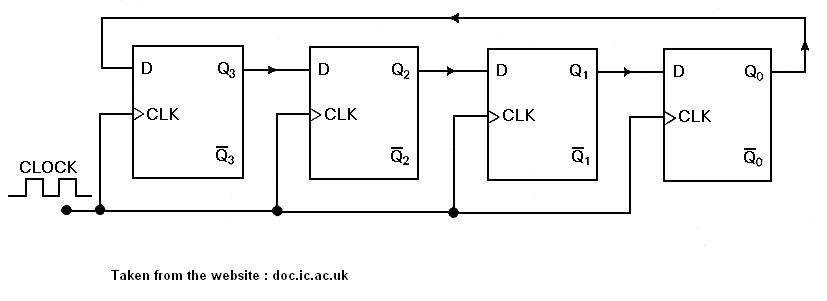
In a Johnsoncounter,theQ output of thelastflip-flop of theshiftregister is connected
to thedatainput of thefirstflip-flop.Thecircuit of a 4-bit, D flip-flopbasedJohnsonCounter is
shown in figure34.16.Thesequence of statesthatareimplemented by a n-bitJohnson
counterare2n.Thus a 4-bitJohnsoncountersequencesthrough 8 statesand a 5-bitJohnson
354
Figure34.164-bitJohnsonCounter
Q0
Q2
Pulse
0
0
1
0
0
1
0
3
1
0
1
1
5
1
1
0
1
7
0
1
Table34.1Sequence of states of a 4-bitJohnsonCounter
TheRingCounter is similar to theJohnsoncounter,exceptthatthe Q output of thelast
flip-flop of theshiftregister is connected to thedatainput of thefirstflip-flop of theshift
register.Alltheflip-flops of thecounterarecleared to logiclowexceptforthefirstflip-flop
PRE
Figure34.174-bitRingCounter
Aftertheinitialization of thecounter,thelogichighset at theoutput of thefirstflip-flop
is shiftedright at eachclocktransition.Table34.2.With a RingCountercircuit no decoding
gatesarerequired.Eachstate of theringcounterhas a uniqueoutput.
Q0
Q2
Pulse
1
0
1
1
0
0
1
3
0
1
355
The following is the VHDL code for 4-bit SIPO in behavioural modelling.
| Source: https://www.ee.usyd.edu.au/tutorials/digital_tutorial/part2/register03.html |
use ieee.std_logic_1164.all;
port( res: in std_logic;
clk: in std_logic;
end sipo;
architecture beh of sipo is
begin
begin
temp<='0000';
temp(3)<=sin;
temp(1)<=temp(2);
end if;
pout<=temp;
USE ieee.std_logic_1164.ALL;
Vhdl Program For 3 Bit Bidirectional Shift Register Of Deeds
END sr;
ARCHITECTURE behavior OF sr IS
--Component Declaration for the Unit Under Test (UUT)
PORT(
sin : IN std_logic;
pout : OUT std_logic_vector(3downto 0)
ENDCOMPONENT;
signal res : std_logic := '0';
signal clk : std_logic := '0';
--Outputs
constant clk_period : time := 50 ns;
BEGIN
uut:sipo PORT MAP (
sin => sin,
pout => pout
clk_process :process
clk<= '0';
clk<= '1';
endprocess;
--Stimulus process
begin
wait for 50 ns;
3 Bit Bidirectional Shift Register
wait for 50 ns;
wait for 50 ns;
wait for 50 ns;
wait for 50 ns;
wait for 50 ns;
wait for 50 ns;
wait for 50 ns;
wait for 50 ns;
wait for 50 ns;
wait for 50 ns;
wait for 50 ns;
wait for 50 ns;
wait;
END;
Waveform:Vhdl Program For 3 Bit Bidirectional Shift Register Free